Female Pattern Baldness in 40s: Causes, Symptoms & Treatment Options
BY TRYBELLO
Jul 16, 2026

Key Takeaways
- Perimenopause and declining estrogen levels in your 40s create the hormonal conditions that allow DHT to accelerate follicle miniaturization, especially in women with a family history of thinning hair.
- Thyroid disorders, iron deficiency, chronic stress, and years of tight hairstyles or heat damage can all trigger or worsen hair loss independently of androgenetic alopecia.
- The earliest warning signs tend to be subtle rather than dramatic, often showing up as a wider part line, less volume at the crown, or noticeably more hair collecting on your brush and pillowcase.
- Effective management combines multiple approaches, including professional therapies like Platelet-Rich Plasma (PRP) injections, targeted nutrition to address internal deficiencies, and consistent topical care with evidence-backed ingredients.
- Trybello offers a range of clean, science-backed hair wellness products formulated with powerful ingredients like biotin, caffeine, and Capixyl™ to help women experiencing thinning hair take action with confidence, all backed by a 120-Day Growth Guarantee.
What Exactly Is Female Pattern Baldness?
Female pattern baldness, also known as androgenetic alopecia, is a progressive condition in which hair follicles become increasingly sensitive to dihydrotestosterone (DHT), a hormone that causes them to shrink over time. As these follicles miniaturize, the hair they produce grows finer, shorter, and more fragile with each cycle until some stop producing visible strands altogether.
Female pattern baldness often becomes noticeable in your 40s because this is when hormonal changes during perimenopause begin to alter the hair growth cycle. As estrogen levels gradually decline, hair spends less time in its active growth phase, while genetically sensitive follicles become more vulnerable to the effects of DHT.
The result is a slow reduction in hair density that may not be obvious at first but becomes increasingly noticeable over time. Around 40% of women experience visible hair loss by age 50, making this one of the most common changes women face during midlife.
“Doctor-Approved Natural Spray Rapidly Boosts Growth & Thickness.
Why 100,000+ Women Are Switching to Trybello!"
Join over 100,000 happy customers who've transformed their hair with our doctor-formulated spray in just 12 weeks, rated 4.8/5 by 40,000+ real users.
Proven Natural Ingredients
- • Caffeine Extract – Blocks DHT and boosts blood flow to follicles
- • Biotin – Direct scalp absorption, no pills needed
- • Castor Oil – Soothes inflammation and locks in moisture
- • Rice Water Extract – Strengthens hair and reduces shedding
120-Day Growth Guarantee: No results? 100% money back, no questions asked.


Why Does Female Pattern Baldness Often Start in Your 40s?
Perimenopause & Declining Estrogen Levels
Perimenopause, which typically begins in the mid 40s, causes estrogen levels to decline significantly. Estrogen plays a protective role in hair growth.
As estrogen drops, DHT's impact on hair follicles becomes more pronounced. The result is that follicles begin to miniaturize, producing thinner, weaker strands until the growth cycle shortens to the point where visible thinning becomes undeniable.
The Genetic Factor
Genetics loads the gun, but hormones pull the trigger. If your mother, grandmother, or even father's side of the family experienced significant hair thinning, your chances of developing female pattern hair loss increase considerably.
The hereditary component of female pattern baldness is polygenic, meaning multiple genes contribute to follicle sensitivity to DHT. Women often don't see these genes expressed until hormonal conditions create the right environment, which is exactly what perimenopause does.

Hair loss in your 40s rarely comes down to a single trigger, which is why understanding all the potential contributors matters.
Other Possible Causes of Hair Loss in Women at 40
Thyroid Disorders & Autoimmune Conditions
Both hypothyroidism and hyperthyroidism can cause diffuse hair shedding that mimics FPHL. The thyroid regulates metabolism and cellular turnover, including in hair follicles, so when it's underperforming or overactive, hair growth cycles are disrupted.
Alopecia areata, an autoimmune condition, is another culprit. It causes the immune system to attack hair follicles, leading to patchy hair loss that can overlap with general thinning.
Nutritional Deficiencies
Iron deficiency is one of the most commonly overlooked causes of hair loss in women. Ferritin (stored iron) is essential for hair follicle cell production, and even a borderline-low level can trigger significant shedding. Deficiencies in vitamin D, zinc, and B vitamins (particularly biotin and B12) also play a role.
Chronic Stress & Telogen Effluvium
Chronic stress triggers a condition called telogen effluvium, a form of hair loss in which a significant number of hair follicles are prematurely pushed into the resting (telogen) phase of the growth cycle.
Normally, about 10%–15% of your hair is in the telogen phase at any given time. Under prolonged stress, that number can spike dramatically, leading to sudden, diffuse shedding across the entire scalp.
Tight Hairstyles & Heat Styling Damage
Traction alopecia is hair loss caused by consistent mechanical tension on the hair shaft and follicle. Years of tight ponytails, braids, extensions, or buns create repeated pulling stress on the follicle that, over time, can cause permanent damage.
Heat styling compounds the problem. Repeated use of flat irons, curling wands, and hair dryers at high temperatures weakens the hair shaft, causing breakage that can be mistaken for hair loss.
Symptoms of Female Pattern Baldness to Watch For
Female pattern baldness doesn't announce itself dramatically. It's a gradual process, which is both a challenge and an opportunity. The earlier you spot the signs, the more options you have.

A widening part, reduced density at the crown, and thinner-feeling strands are among the most common early symptoms of female pattern baldness.
Widening Hair Part & Crown Thinning
The widening part is often the first visible sign of female pattern hair loss. It happens because follicles along the central parting and crown are typically the most sensitive to DHT, making them the first to miniaturize.
Crown thinning follows a similar pattern. Rather than a single bald spot, you'll notice an overall reduction in volume at the top of the head. It’s almost like the hair is deflating from the center outward.
Receding Hairline & M-Shaped Pattern
A dramatically receding hairline is more associated with male pattern baldness. However, women with female pattern hair loss may experience a subtler form, particularly at the temples. An "M-shaped" frontal hairline or temple recession in women often signals androgenetic alopecia.
Increased Hair Shedding
Losing 50–100 hairs per day is considered normal. When you're consistently seeing significantly more than that, with clumps in the drain, heavy accumulation on your pillow, or a brush full of hair after one pass, it's a sign that the hair cycle is disrupted.
Treatment Options for Female Pattern Baldness in 40s
Platelet-Rich Plasma (PRP) Therapy
PRP therapy involves drawing a small amount of your own blood, spinning it in a centrifuge to concentrate platelets and growth factors, and then injecting the concentrated plasma directly into areas of thinning on the scalp.
The growth factors stimulate dormant or weakened follicles, encourage new blood vessel formation, and extend the anagen (growth) phase of the hair cycle.
Nutritional Interventions & Supplements
Topical and laser treatments perform best when the body has the raw materials it needs for hair growth. Priority areas include restoring iron and ferritin levels to the optimal range and maintaining sufficient protein intake since hair is made almost entirely of keratin, a protein.
Targeted supplements formulated specifically for women in perimenopause and menopause address multiple physiological pathways simultaneously, including stress hormones, inflammation, and DHT sensitivity.
Scalp & Topical Hair Care
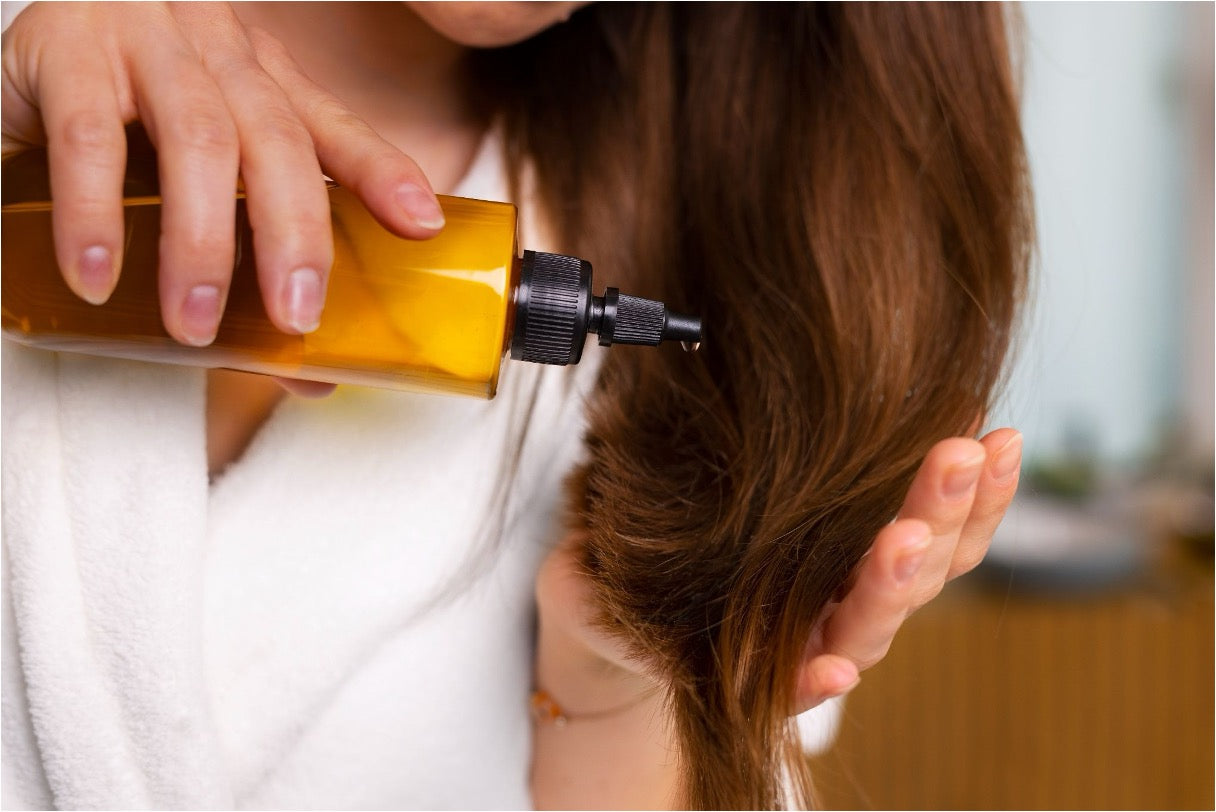
What you put on your scalp matters just as much as what you take internally. A clean, well-circulated scalp creates the optimal environment for follicle function.
Look for products that include these evidence-supported ingredients:
- Biotin supports keratin production at the source, which helps strengthen hair from the root and reduce breakage where thinning is most visible.
- Caffeine-based topicals have been shown to penetrate the hair follicle and help counteract DHT-related miniaturization. They also extend the anagen (growth) phase of the hair cycle, keeping strands in active growth for longer.
- Peptide serums contain biomimetic peptides that support follicle repair and help improve scalp circulation.
- Niacinamide improves the scalp's barrier function and supports healthy hair follicle cycling.
Equally important is what to avoid. Sulfate-heavy shampoos, silicone buildup, and aggressive scalp scratching can all compromise the scalp barrier and worsen inflammation around follicles.
Switch to a gentle, pH-balanced cleanser, use a wide-tooth comb on wet hair, and limit heat styling to reduce mechanical stress on already-thinning strands.
Take Back Control of Your Hair Health with Trybello

Trybello Hair Helper Spray targets the hormonal and DHT-related factors behind hair loss after 40.
Hair loss in your 40s is common, but it doesn't have to be permanent. The earlier you identify the signs of female pattern baldness and build a consistent care routine, the better your chances of slowing progression and restoring visible density. Understanding what's happening at the follicle level puts you in a position to make informed, proactive choices about your hair health.
At Trybello, we combine topical scalp care with internal nutritional support to help women strengthen, thicken, and revitalize thinning hair. Our Trybello Hair Helper Spray delivers biotin, caffeine, and castor oil directly to the follicle, while the Trybello Hair Helper Spray Plus takes it further with Capixyl™, a biomimetic peptide complex that helps support thicker, stronger-looking hair from the root. We are a US-based brand, and all our products are vegan, cruelty-free, and backed by our 120-Day Growth Guarantee. Shop Trybello today and give your hair the fresh start it deserves.
Frequently Asked Questions (FAQs)

Trending Topics




*Disclaimer: Individual results may vary. The information provided in this article is for educational purposes only and is not intended as medical advice. Consult a healthcare professional before starting any new hair or lash care regimen, especially if you have sensitivities or underlying health conditions. Product pricing is subject to change. For full terms, visit Trybello.com.

See our latests posts #TRYBELLO