Female Pattern Hair Loss vs Menopause Hair Loss: Differences & Treatments
BY TRYBELLO
Jul 2, 2026

Key Takeaways
- Female pattern hair loss is a genetic condition that progresses gradually, while menopause hair loss is triggered by the sharp decline in estrogen and progesterone.
- Female pattern hair loss typically shows as a widening central part and crown thinning, while menopause-related shedding often causes diffuse thinning across the whole scalp.
- Female pattern hair loss requires ongoing treatment and cannot be fully reversed without intervention, whereas menopause-related telogen effluvium is usually temporary and self-resolving.
- Effective treatment options overlap between the two conditions, including the Trybello Hair Helper Spray, minoxidil (topical or oral), and anti-androgen medications.
- The Trybello Hair Helper Spray provides daily support, combining caffeine, biotin, castor oil, and rice water extract to fortify follicles and reduce shedding caused by both conditions.
What are the Differences Between Female Pattern Hair Loss & Menopause Hair Loss?
Female pattern hair loss is a genetically inherited form of hair loss driven by follicle sensitivity to androgens, particularly DHT. It develops slowly, often over years or decades, and can begin as early as a woman's 20s or 30s.
Menopause hair loss, by contrast, is a hormone-shock response. When estrogen and progesterone levels drop sharply during perimenopause and menopause, the hair growth cycle becomes destabilized, leading to diffuse shedding and accelerated pattern thinning.
Menopause can trigger telogen effluvium (temporary shedding), accelerate underlying FPHL that was previously subtle, and occasionally set off related conditions like frontal fibrosing alopecia. Because the underlying mechanisms differ (genetic androgen sensitivity vs. estrogen deficiency), the treatment approach benefits from understanding which condition you're actually dealing with, or whether both are the issue.
“Doctor-Approved Natural Spray Rapidly Boosts Growth & Thickness.
Why 100,000+ Women Are Switching to Trybello!"
Join over 100,000 happy customers who've transformed their hair with our doctor-formulated spray in just 12 weeks, rated 4.8/5 by 40,000+ real users.
Proven Natural Ingredients
- • Caffeine Extract – Blocks DHT and boosts blood flow to follicles
- • Biotin – Direct scalp absorption, no pills needed
- • Castor Oil – Soothes inflammation and locks in moisture
- • Rice Water Extract – Strengthens hair and reduces shedding
120-Day Growth Guarantee: No results? 100% money back, no questions asked.


What Is Female Pattern Hair Loss?
Female pattern hair loss is the most common form of hair loss in women, and it's a gradual, progressive condition driven by a combination of genetics, androgens, and hair follicle sensitivity. Unlike sudden shedding events, it unfolds slowly, often over years, which is part of why it can be so far along before it's even noticed.
Female pattern hair loss is strongly genetic, but genetics alone don't tell the whole story. Androgens also play a significant role, though the exact hormonal mechanism in women is still not fully understood.
Unlike male pattern baldness, which typically starts at the temples or crown, FPHL tends to show up first as widening of the central part of the scalp. Women often notice their part looks broader, or that their ponytail feels thinner. The frontal hairline is usually preserved, a key visual distinction between FPHL and other forms of hair loss.
What is Menopause Hair Loss?
Menopause fundamentally reshapes the hormonal environment that your hair follicles depend on to thrive.
During menopause, estrogen and progesterone levels decline sharply. With less estrogen acting as a counterbalance, androgens become relatively more dominant. The anagen phase shortens, hair sheds faster, grows back more slowly, and each strand becomes progressively finer.
For women who are also genetically predisposed to female pattern hair loss, menopause can dramatically accelerate a process that might have otherwise remained subtle for decades. Additionally, menopause can trigger or worsen several distinct hair loss conditions, including telogen effluvium and frontal fibrosing alopecia.
Female Pattern Hair Loss vs. Menopause Hair Loss: Key Differences
Cause & Hormonal Drivers
Female pattern hair loss is rooted in androgen sensitivity and genetic predisposition. It can begin as early as a woman's 20s or 30s and progresses independently of menopause, though menopause can make it worse.
Menopause-related hair loss, by contrast, is primarily driven by the loss of estrogen's protective effects on the hair cycle. It's a hormonal deficiency problem, not an androgen sensitivity problem, though both mechanisms can coexist in the same woman.
Pattern & Location of Thinning
Female pattern hair loss typically produces a diffuse thinning across the crown with a widening center part, while the frontal hairline remains intact. Telogen effluvium, which is one of the most common menopause-triggered hair loss, causes all-over shedding that can feel alarming but is usually temporary. Frontal fibrosing alopecia is immediately recognizable by its receding frontal hairline, sometimes accompanied by eyebrow and eyelash loss.
A dermatologist will assess not just where hair is thinning but also the quality of the remaining hair, scalp condition, and sometimes perform hair pull tests to determine how many follicles are actively shedding. In more complex cases, a scalp biopsy provides definitive answers, especially when scarring alopecia is suspected.

Female pattern hair loss typically starts at the crown, while menopause-triggered hair loss starts all over the scalp.
Permanent or Temporary?
Whether hair loss becomes permanent depends almost entirely on the type of hair loss and how quickly it's addressed. Telogen effluvium is typically temporary. Most women see significant regrowth within six to twelve months once the triggering hormonal shift stabilizes, though this varies by individual health factors.
Female pattern hair loss and frontal fibrosing alopecia are a different story. Both are progressive and chronic. Female pattern hair loss can be slowed, stabilized, and in some cases partially reversed, but only if follicles are still alive and responsive. Once follicles scar over, as happens in advanced FFA, that hair is gone permanently.
Treatment Options for Female Pattern Hair Loss & Menopause Hair Loss
1. Trybello Hair Helper Spray

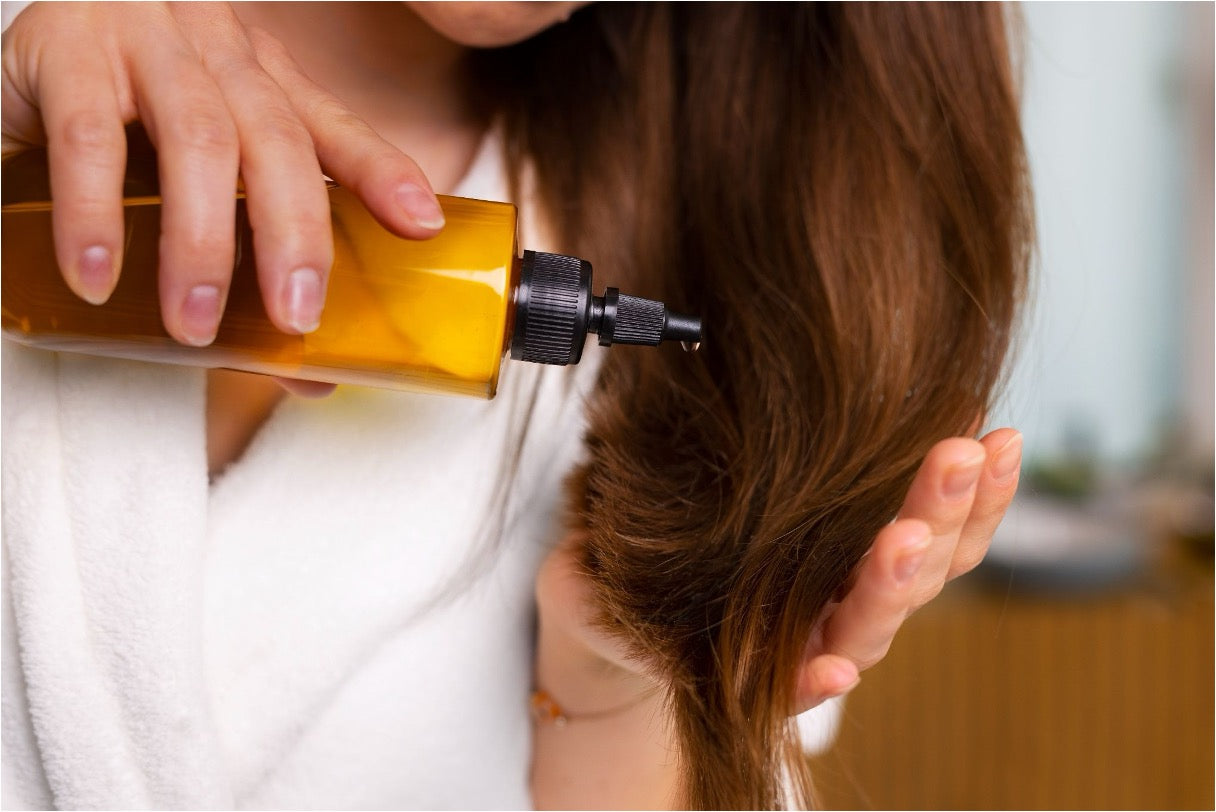
The Trybello Hair Helper Spray is lightweight, non-greasy, and gentle enough for daily use.
Our Trybello Hair Helper Spray is a leave-in scalp treatment designed to support hair recovery across hormonally driven thinning, whether that's the gradual miniaturization of female pattern hair loss or the hormone-related shedding that intensifies during menopause. It's formulated around a clean, science-backed ingredient stack that targets the mechanisms underlying these conditions.
The Trybello Hair Helper Spray is infused with caffeine, among other clean, natural ingredients. Caffeine may help counter DHT's effects at the follicle and prolong the anagen growth phase, which matters for both female pattern hair loss and menopause hair loss, where growth cycles shorten.
It also contains biotin, which fortifies the keratin structure of new strands, castor oil, which calms inflammation, and rice water extract, which adds strand-level support against breakage. Together, they create the kind of daily environment that thinning hair needs to hold on to more of what remains and regrow with better structure.
2. Minoxidil (Topical or Oral)
Minoxidil is the most extensively studied treatment for both female pattern hair loss and menopause-related thinning, and it remains the frontline pharmaceutical option for most women. It works by prolonging the growth phase of the hair cycle and improving blood flow to the follicle, which helps counter the miniaturization at the heart of both conditions.
Topical minoxidil (2% or 5%) is applied directly to the scalp, while low-dose oral minoxidil (typically 0.25mg to 2.5mg daily) has grown in popularity among women seeking more consistent systemic delivery or who experience scalp irritation with the topical formula.
3. Anti-Androgen Medications
Anti-androgens work by reducing the impact of DHT on scalp follicles, which is a shared underlying driver of both female pattern hair loss and much of menopausal hair thinning.
The most commonly prescribed options work by blocking the enzymes that convert testosterone into DHT and require a prescription and periodic monitoring. Results generally build over 3 to 6 months, and treatment is long-term.
Female Pattern Hair Loss vs. Menopause Hair Loss: Comparison Table
| Feature | Female Pattern Hair Loss (FPHL) | Menopause Hair Loss |
|---|---|---|
| Primary Cause | Genetic androgen sensitivity and follicle miniaturization | Estrogen and progesterone decline during hormonal transition |
| Onset Speed | Gradual, often years or decades | Onset during or after perimenopause; can be sudden or gradual |
| Pattern of Loss | Widening central part, thinning at the crown | Diffuse all-over shedding; may accelerate underlying FPHL |
| Frontal Hairline | Usually preserved | Usually preserved |
| Age of Typical Onset | Can begin in the 20s or 30s; often noticeable by the 40s | Peri-menopausal and post-menopausal years (typically 40s–50s+) |
| Reversibility | Progressive; can be slowed or stabilized with treatment | Menopause telogen effluvium is typically temporary; underlying FPHL is progressive |
| Duration | Lifelong without treatment | Menopause telogen effluvium usually resolves within 6 to 12 months |
Why Trybello Hair Helper Spray Is the Best Option for Female Pattern Baldness & Menopause Hair Loss

The Trybello Hair Helper Spray contains clean ingredients and is good for all hair types.
Female pattern hair loss demands long-term consistency, and menopausal hair loss needs supportive care during the transition while the growth cycle stabilizes on its own. When both conditions overlap, as they often do in women over 40, the treatment plan usually combines prescription options with daily topical care that reinforces the scalp environment in which those medications work.
Our Trybello Hair Helper Spray provides the topical care needed to counter the DHT effects that drive follicle miniaturization in female pattern hair loss and hormonally driven thinning. Because it's vegan, cruelty-free, and free of harmful substances, it can safely be used alongside layered treatment plans. Many women report noticeable improvements in volume and reduced shedding within 4 to 6 weeks, and every purchase is backed by our 120-Day Growth Guarantee. Try the Trybello Hair Helper Spray to support fuller, healthier-looking hair.
Frequently Asked Questions (FAQs)

Trending Topics




*Disclaimer: Individual results may vary. The information provided in this article is for educational purposes only and is not intended as medical advice. Consult a healthcare professional before starting any new hair or lash care regimen, especially if you have sensitivities or underlying health conditions. Product pricing is subject to change. For full terms, visit Trybello.com.

See our latests posts #TRYBELLO