Telogen Effluvium vs Female Pattern Baldness: Differences, Symptoms & Treatment
BY TRYBELLO
Jul 6, 2026

Key Takeaways
- Telogen effluvium is temporary. It's triggered by a stressor like illness or nutritional deficiency, and most women recover within 6 months once the trigger is addressed.
- Female pattern baldness is permanent without treatment. It's driven by genetics and androgens, causing progressive follicle miniaturization that doesn't reverse on its own.
- Telogen effluvium causes diffuse shedding all over the scalp, while female pattern baldness typically starts at the crown and part line.
- Treatment paths overlap in some areas: nutritional correction and low-level laser therapy support both conditions, while prescription minoxidil and anti-androgens are typically best for female pattern baldness.
- For daily support alongside any recovery plan, the Trybello Hair Helper Spray provides clean, science-backed topical care with caffeine, biotin, castor oil, and rice water extract to support scalp health and reduce visible shedding.
How to Tell Whether Your Hair Loss Is Temporary or Progressive
The answer usually comes down to timing and pattern. If shedding appears suddenly and is evenly distributed across your scalp, the likely cause is telogen effluvium, a reactive condition that follows a triggering event by roughly two to three months. If thinning has gradually crept in around your part line and crown over months or years, female pattern baldness, clinically called androgenetic alopecia, is the more likely diagnosis.
Getting that distinction right matters because each condition responds differently to treatment. Misidentifying one for the other can mean months spent on the wrong plan while damage continues. A dermatologist can confirm the diagnosis through a scalp exam, hair pull test, or trichoscopy, and early intervention consistently produces the strongest outcomes for both conditions.
The Trybello Hair Helper Spray supports both recovery paths as a daily topical layer, delivering caffeine and biotin directly to the follicle environment without interfering with prescription treatments. Every bottle is backed by a 120-Day Growth Guarantee.
“Doctor-Approved Natural Spray Rapidly Boosts Growth & Thickness.
Why 100,000+ Women Are Switching to Trybello!"
Join over 100,000 happy customers who've transformed their hair with our doctor-formulated spray in just 12 weeks, rated 4.8/5 by 40,000+ real users.
Proven Natural Ingredients
- • Caffeine Extract – Blocks DHT and boosts blood flow to follicles
- • Biotin – Direct scalp absorption, no pills needed
- • Castor Oil – Soothes inflammation and locks in moisture
- • Rice Water Extract – Strengthens hair and reduces shedding
120-Day Growth Guarantee: No results? 100% money back, no questions asked.


What Is Telogen Effluvium?
Telogen effluvium is a form of temporary, diffuse hair shedding that occurs when a significant number of hair follicles are pushed prematurely into the telogen (resting) phase of the hair growth cycle. Instead of the normal 10–15% of follicles resting at any given time, that number can reach 30%, causing noticeable, sometimes alarming, hair loss across the entire scalp.
The condition is typically reactive, meaning something happened to your body first, and the hair loss follows weeks to months later. That delay is one reason many women struggle to connect the dots between a triggering event and their shedding.
Common Symptoms of Telogen Effluvium
Telogen effluvium symptoms tend to appear all at once and can feel alarming. The most common signs include:
- A sudden, noticeable increase in daily hair shedding, often two to three months after a triggering event
- Clumps of hair in the shower drain, on your pillow, or in your brush that weren't there before
- Diffuse thinning spread evenly across the entire scalp rather than concentrated in one area
- Shedding that increases noticeably during washing or light pulling
What Is Female Pattern Baldness?
Female pattern baldness, clinically known as androgenetic alopecia, is a genetically driven, progressive form of hair loss that affects the density and diameter of hair follicles over time. Unlike telogen effluvium, it is not triggered by a single event. It develops slowly, often going unnoticed until meaningful miniaturization of the follicles has already occurred.
The primary driver of female pattern baldness is a genetic sensitivity of hair follicles to androgens, specifically dihydrotestosterone (DHT), a derivative of testosterone. In genetically susceptible women, DHT binds to receptors in scalp follicles and gradually shrinks them. Estrogen normally helps counteract this process, which is why many women first notice significant thinning after menopause when estrogen levels decline.
Common Symptoms of Female Pattern Baldness
Female pattern baldness develops quietly, and many women don't recognize the signs until significant thinning has already occurred. Watch for:
- A gradually widening central part that becomes more visible over months or years
- Progressive thinning concentrated at the crown, with the frontal hairline staying mostly intact
- Individual hair strands becoming finer in diameter, making the scalp more visible under bright light
- Reduced overall hair density without a dramatic shedding event
- Slower regrowth after normal hair cycling, with new strands appearing thinner and weaker than before
Key Differences Between Telogen Effluvium & Female Pattern Baldness
Speed of Onset
Telogen effluvium often feels like it comes out of nowhere. Women frequently report a dramatic increase in shedding over days to weeks, which shows up as handfuls in the shower, significant hair on the pillow, and a visibly thinner ponytail.
Female pattern baldness, by contrast, is a slow thief. It develops over months to years, with hair thinning progressing so gradually that many women don't seek help until they've already experienced significant loss of density. The hair simply becomes finer and less dense over time without a dramatic shed event.

With telogen effluvium, hair loss seems to appear suddenly and be more noticeable.
Where Hair Loss Appears on the Scalp
Telogen effluvium causes diffuse shedding. The hair thins relatively evenly across the entire scalp, including the sides and back. The frontal hairline is typically preserved.
Female pattern baldness follows a predictable pattern. Thinning begins at the crown and central part line. The part gradually widens, the crown becomes increasingly sparse, and the frontal hairline is usually maintained, at least in the early stages.

Female pattern baldness often starts at the crown and gradually widens until it affects the entire scalp.
Reversibility
Acute telogen effluvium is largely self-resolving. Once the triggering event is identified and addressed, the hair growth cycle typically normalizes within 3 to 6 months. Most women see meaningful regrowth within a year, and in many cases, full density returns.
Female pattern baldness does not reverse on its own. Without treatment, the process of follicle miniaturization continues uninterrupted. The hair that has already been lost to advanced miniaturization will not return without medical intervention, and even with treatment, the goal shifts from reversal to stabilization and modest regrowth.
Age of Onset
Telogen Effluvium can affect women of any age, typically following a specific triggering event. It is most commonly seen in women of reproductive age, but also frequently occurs in women aged 40–60 experiencing hormonal transitions, thyroid changes, or nutritional shifts.
Female Pattern Baldness becomes increasingly prevalent with age. While it can begin in a woman's 20s, it most commonly becomes noticeable in the 40s and 50s, with prevalence rising sharply after menopause.
Treatment Options for Telogen Effluvium & Female Pattern Baldness
While telogen effluvium and female pattern baldness are distinct conditions with different mechanisms, several treatment approaches can support recovery or slow progression in both conditions.
1. Trybello Hair Helper Spray
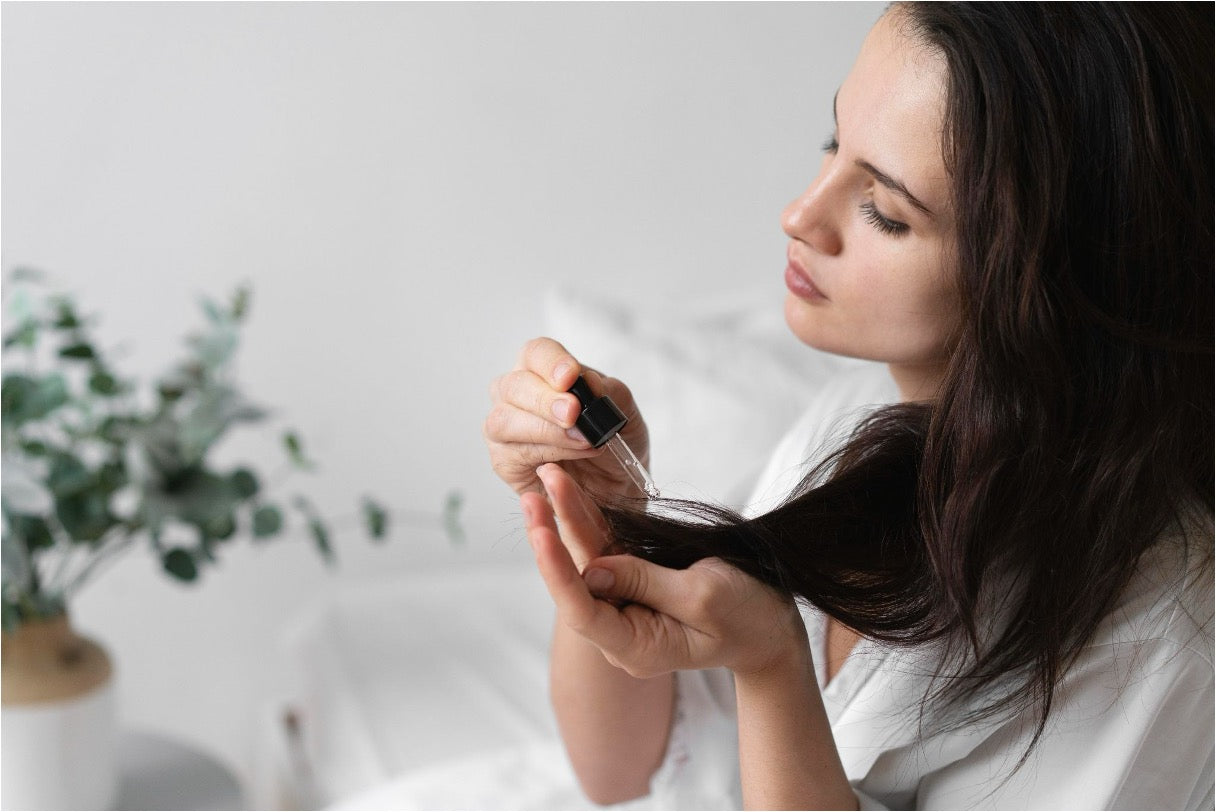
The Trybello Hair Helper Spray is a leave-in topical treatment formulated to support hair recovery from a wide range of thinning and shedding conditions, including both telogen effluvium and female pattern baldness. It's built around a combination of clean, science-backed ingredients (caffeine extract, biotin, castor oil, and rice water extract), each chosen for its documented role in supporting follicle health, scalp circulation, and stronger strand structure.
For telogen effluvium, the spray helps address the reactive nature of the condition. Caffeine supports scalp blood flow and has been studied for its potential to extend the anagen (growth) phase, which telogen effluvium prematurely shortens.
Biotin supports the structural proteins that make up the hair shaft, helping new strands emerge stronger as recovery begins, while castor oil soothes inflammation and adds hydration to a scalp environment that may already be sensitized by stress or hormonal shifts.
For female pattern baldness, the spray fits well as a supportive layer alongside longer-term treatments. While it isn't a replacement for prescription options like minoxidil or anti-androgens, its ingredient profile supports the follicular environment in which those medications work. Users can integrate it into a broader treatment plan without worrying that harsh ingredients will interfere with results.

The Trybello Hair Helper Spray contains caffeine extract, biotin, and castor oil, which reduce hair shedding.
2. Nutritional Support & Deficiency Correction
Nutritional deficiencies contribute to both telogen effluvium and female pattern baldness, though the emphasis differs slightly. For Telogen effluvium, deficiencies are often the direct cause; correcting them is the treatment. For female pattern baldness, they aren't the root cause, but they compound the follicle miniaturization already underway and slow the effectiveness of other interventions.
Iron deficiency, specifically low ferritin, is one of the most common and most correctable drivers of chronic shedding in women. Supplementation with iron (under medical supervision), vitamin D3, biotin, and zinc can meaningfully support recovery when deficiencies are confirmed.
Food-based sources like red meat, lentils, dark leafy greens, eggs, salmon, and pumpkin seeds should be prioritized alongside targeted supplementation.
3. Low-Level Laser Therapy (LLLT)
Low-level laser therapy uses specific wavelengths of red light to stimulate cellular activity within hair follicles, extending the anagen phase and improving follicle function.
For telogen effluvium, LLLT can help accelerate the recovery timeline once the underlying trigger has been addressed by supporting the return to a healthy growth cycle. For female pattern baldness, it's typically used as an adjunct therapy alongside minoxidil or anti-androgens, adding another layer of follicle stimulation without introducing additional side effects.
Telogen Effluvium vs Female Pattern Baldness: Comparison Table
| Feature | Telogen Effluvium | Female Pattern Baldness |
|---|---|---|
| Cause | Triggered by stress, illness, nutritional deficiency, hormonal shift | Genetic sensitivity to androgens (DHT) |
| Onset Speed | Sudden: noticeable within weeks of trigger | Gradual: develops over months to years |
| Pattern of Loss | Diffuse, even shedding across entire scalp | Central part and crown; frontal hairline preserved |
| Reversibility | Yes: typically resolves once trigger is removed | No: permanent without ongoing treatment |
| Duration | Acute: under 6 months; Chronic: 6+ months | Lifelong and progressive without treatment |
| Peak Age of Onset | Any age; common postpartum and perimenopausal | 40s–60s; accelerates after menopause |
Choose Trybello Hair Helper Spray for Targeted Hair Support
Telogen effluvium and female pattern baldness demand different long-term strategies, but both benefit from daily topical support that works with the scalp rather than against it. Telogen effluvium recovery centers on addressing the trigger and allowing the growth cycle time to normalize, while female pattern baldness requires ongoing intervention to slow miniaturization and support any remaining regrowth.
Our Trybello Hair Helper Spray is designed to support scalp circulation, follicle strength, and shaft structure. Because the formula is vegan, cruelty-free, and free of parabens, sulfates, and synthetic fragrances, it's safe to layer with prescription options and gentle enough for sensitive scalp conditions that telogen effluvium and female pattern baldness often bring. Plus, many users report visible improvements in volume and reduced shedding within 4 to 6 weeks. Try the Trybello Hair Helper Spray for faster hair growth results today.
Frequently Asked Questions (FAQs)

Trending Topics






*Disclaimer: Individual results may vary. The information provided in this article is for educational purposes only and is not intended as medical advice. Consult a healthcare professional before starting any new hair or lash care regimen, especially if you have sensitivities or underlying health conditions. Product pricing is subject to change. For full terms, visit Trybello.com.

See our latests posts #TRYBELLO